
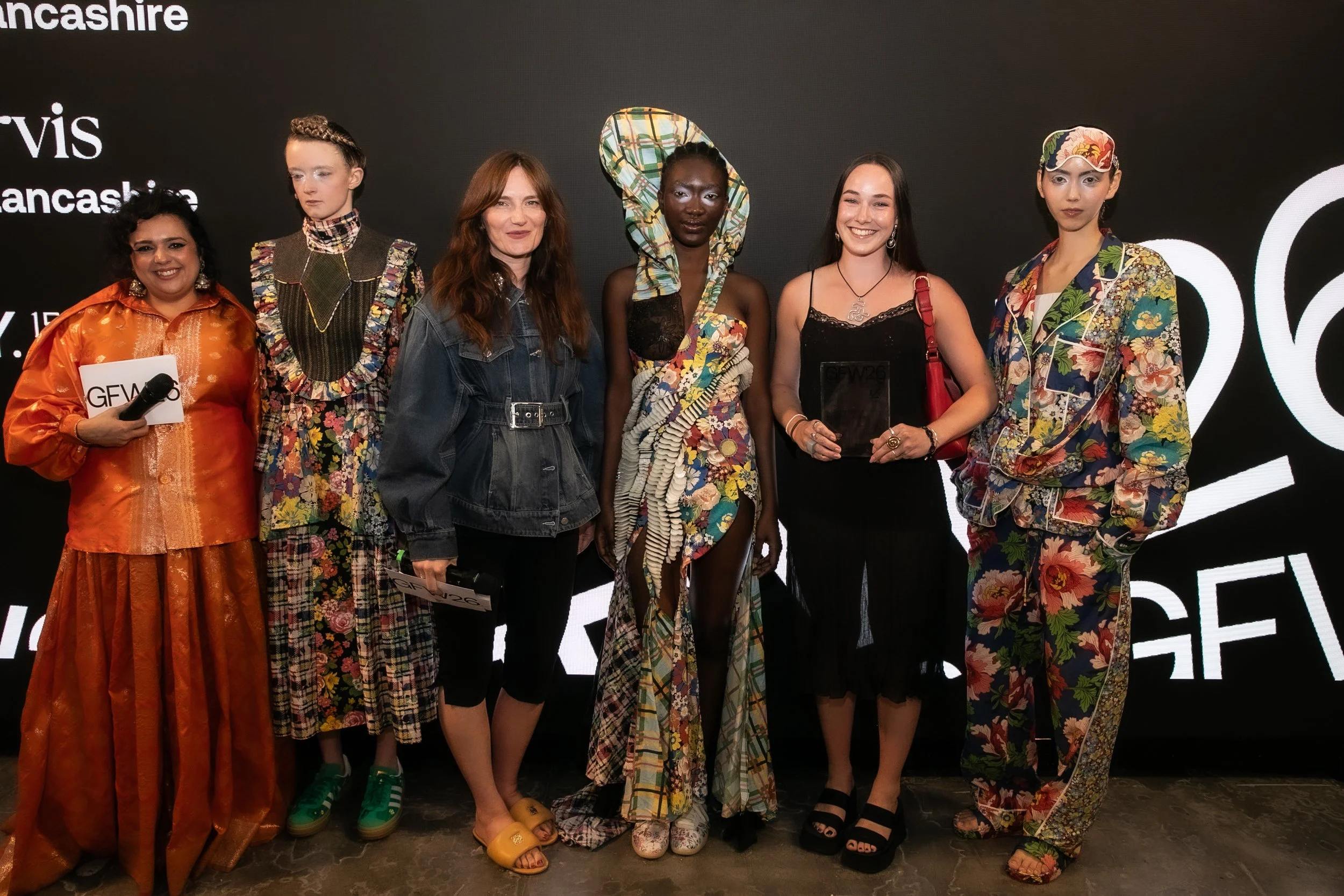
An Interview with the winner of the GFW x Liberty Fabrics Catwalk Award 2026: Cerys Scott Hobbs from Manchester Fashion Institute
Cerys Scott Hobbs is a womenswear designer and fashion freelancer based in Edinburgh, working from her own studio. She recently graduated with a First-Class Honours degree in Fashion Design and Technology from the Manchester Fashion Institute, which included a placement year at Strathberry as a product development and production intern.
As a designer, Cerys has a strong focus on conceptual design that bridges the gap between elegant, bold aesthetics and high-quality construction. She achieves this through technical pattern cutting and draping, innovation in the design and production process, currently utilizing 3D printing, and meticulous attention to detail in her sewing and finishings.
Her creative process begins with a theme or idea that she develops through research, sketching, material innovation, and sampling until it becomes a strong, consistent story. As a hands-on, visual worker, she always begins with draping once her concept is established. She photographs her drapes, collages the images with research material and fabric swatches, and repeats the process until a buildable collection forms. She always starts by defining the silhouettes, shapes, and structures that resonate with her concept before moving on to details, finding this to be the most organic approach for her work.
Cerys draws most of her initial concepts from within. Her concepts frequently build around her Scottish heritage, her health, or her social opinions, and her work usually celebrates multiple broad themes hidden within the narrative. For instance, her final collection centered on the Scottish Witch Hunts of the 15th to 17th centuries, focusing on the treatment of women as one of the earliest forms of misogyny and drawing parallels to modern-day feminist issues.
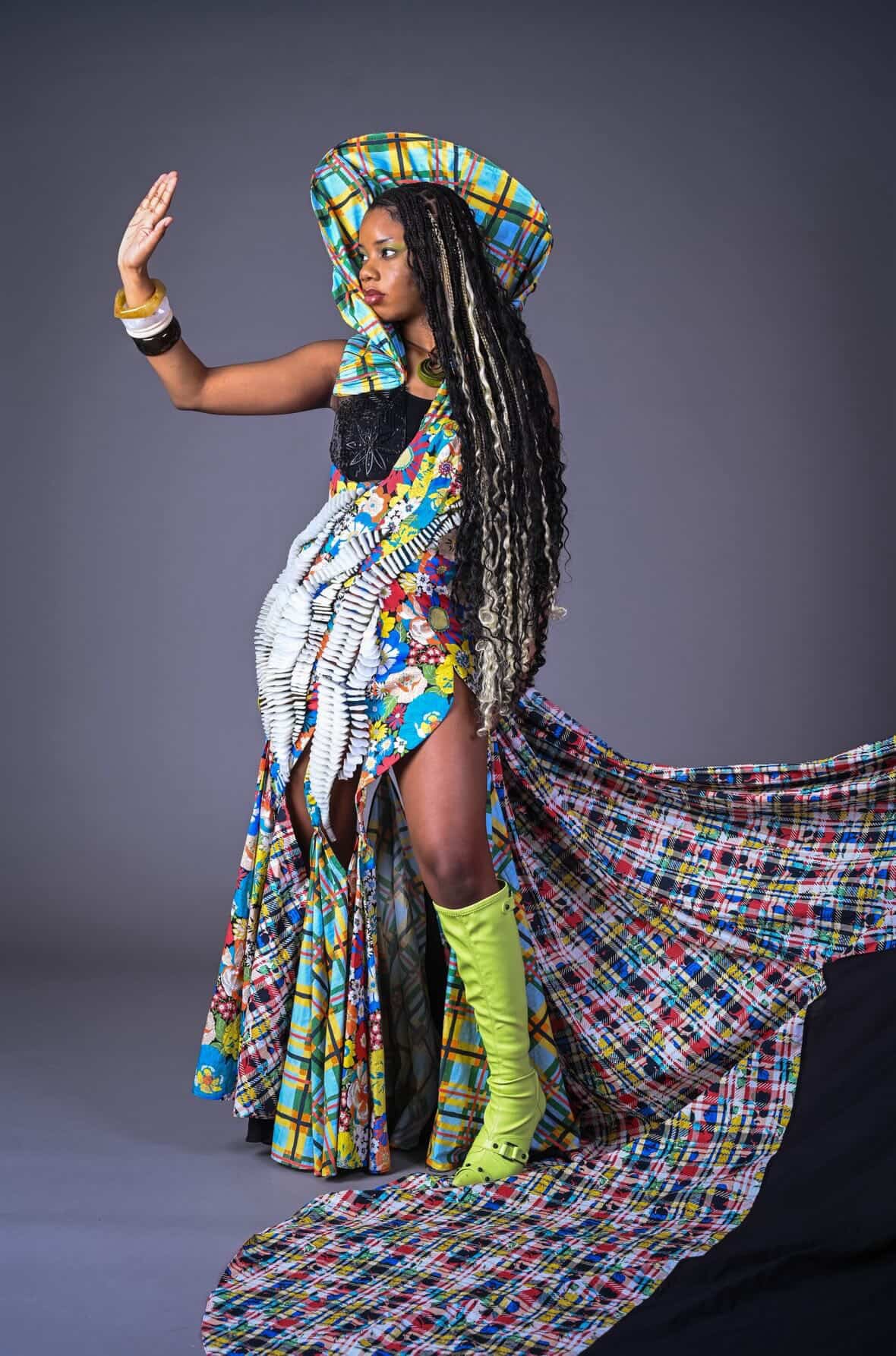

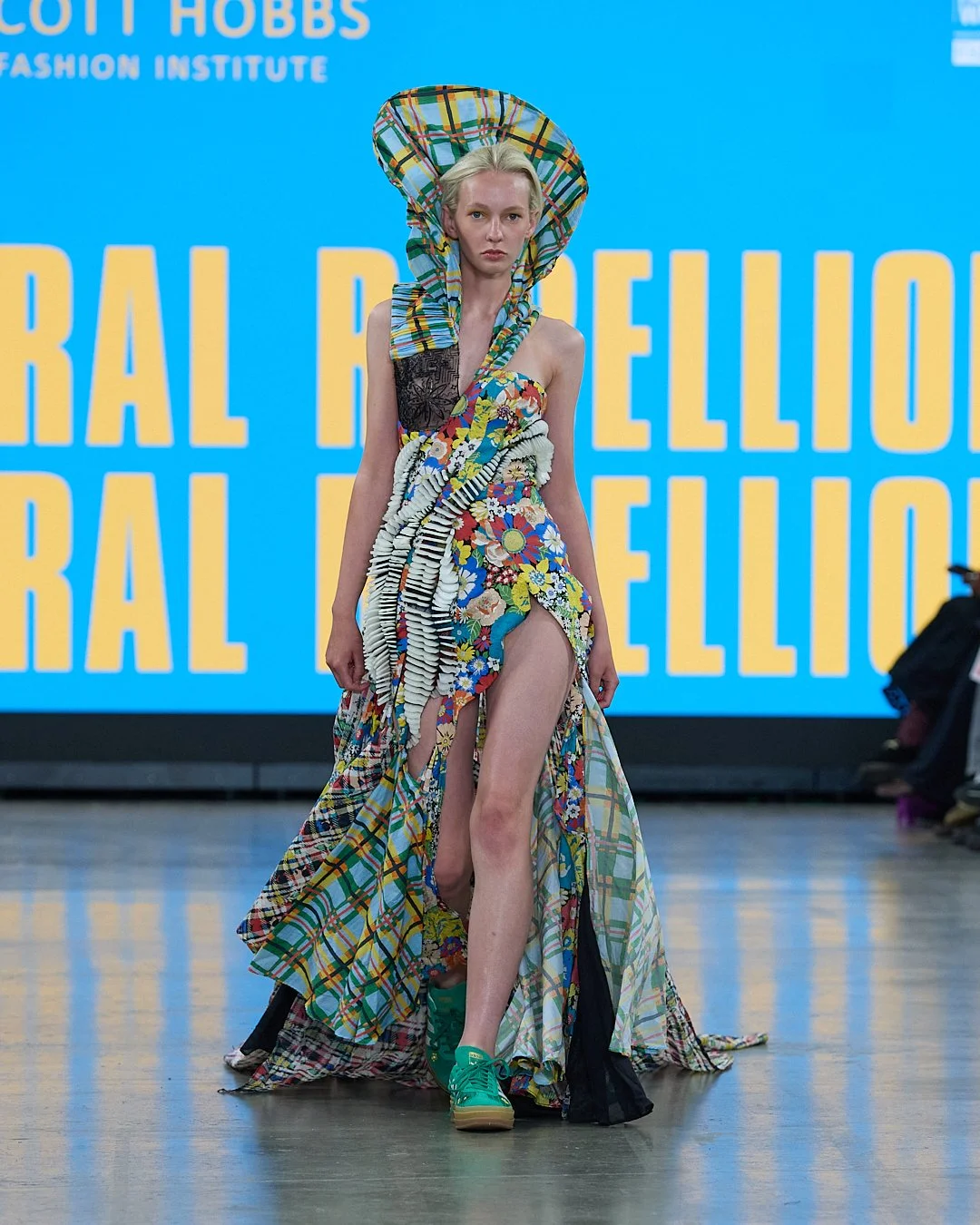
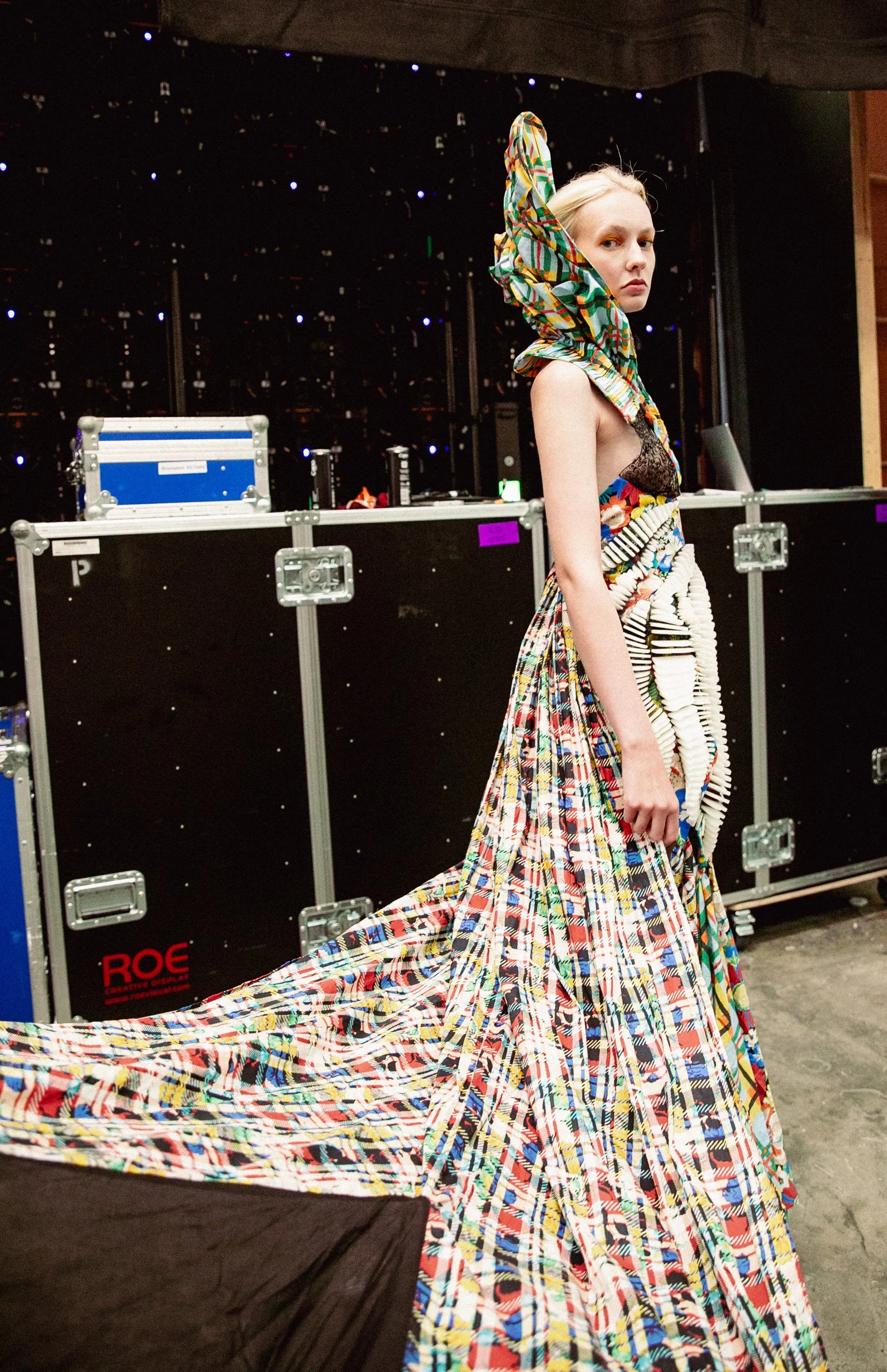
What unexpected source influenced your final outcome?
“Technology is definitely something that has influenced my final outcome. The use of 3D printing can be seen throughout my design in multiple different ways, which is something I did not expect, going into this project. Having never used 3D printing before or known much about it, there was a massive learning curve to work through in a short amount of time. It took a lot of sampling, testing different materials, both in the 3D prints and in the fabric they are printed onto, and in many other aspects of the process, such as; how the print would attach to the fabric, how large or small the pieces could be, how far apart they had to be, and there was a lot of ‘failed’ tests throughout this process.
I used Fusion360 to design the prints, which I had used a little in school before, but I had to re-learn the program and how to use it for this process, including getting my patterns from Gerber AccuMark into Fustion360 so I could develop my prints directly onto my patterns. This started as a very slow process as I was designing each print individually, however I learned quickly and began to find strategies to become more efficient on Fusion360 and with using and troubleshooting the Ultimaker printers, in which I had great support with from PrintCity.
Had this design not included the 3D printing, it would still be a complex design due to the form fitted, creative pattern cutting and engineered structure. However, I think the 3D printing is the part of the design which makes it stand out and feel very innovative, without which it may have lacked such a unique quality, it is the element that I am most proud of.”
What’s the best piece of creative advice you’ve ever received?
“One of my lecturers in uni, Adrian Thornton, has a saying along the lines of, “happy accidents lead to the best outcomes”, and I think this is the best piece of advice I’ve ever received. It has helped me grow, especially in my technical pattern cutting skills, because, as soon as I started viewing so called ‘failures’ as opportunities to grow and develop my skills, I stopped being afraid of doing something wrong and started pushing my skills to new levels, which developed my understanding of the process much quicker.
And he was right, some of my best designs have come from sampling that didn’t have the outcome I expected, often leading to an improvement on any idea I could have come up with without that trial and error. I think this is a big factor as to why I begin with draping in my creative process, the aim isn’t to already have an idea of how it will turn out; which allows me to not set boundaries on my creativity.”
How would you describe your creative voice in three words?
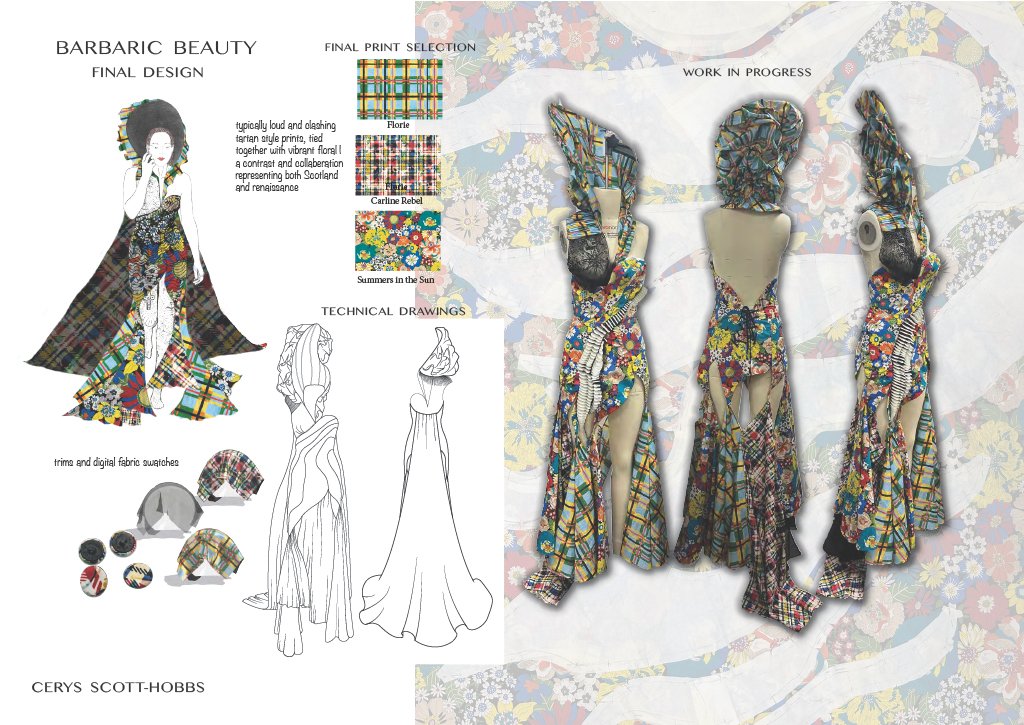
“Though I find it difficult to describe my creative voice in only three words, as I think each collection and design I make has its own creative voice, each of which adds to my plethora of artistic expression. I think, based on my designs to date and focussing specifically on my ‘Barbaric Beauty’ collection, the top three words that come to mind are experimental, exuberant, and technical. ”
What kind of impact do you hope your work has beyond aesthetics?
“I think aesthetics are very important in fashion. When it comes down to it, aesthetics are the reason a consumer will purchase a garment or not. However, I believe there is so much more to fashion than just aesthetics, whether the depth of a collection is known to the consumer or not, it is much like art in that it can be perceived differently to every viewer. Fashion is routed in so many important periods of history and makes a multitude of socially political statements. I want my work to be a catalyst of change in the fashion industry, every time I design a collection it has a statement behind the concept. My ‘Let’s Talk Sh*t’ collection, had an obvious desire to raise awareness to hidden disabilities, my graduate collection ‘Whisper of Glamer’ was showing the lack of choice or voice for women who are trapped in the patriarchy, but this collection could have been read in many different ways and my ‘Barbaric Beauty’ collection was highlighting the historical ethnocide of Scottish culture and how tartan as a rebellious symbol is also part of a deep routed culture. This statement of the collection may not have been clear to anyone but myself, however, I believe that the best fashion pieces and collections are designed with a purpose which speaks to an audience, big or small.”
Which designer, artist or creative would you most like to show your work to?
“Throughout the past four years, so many incredible creatives have inspired my design process. The designers who consistently inspire the creativity, innovation, technicality, attention to detail and conceptual thinking in my work are; Vivienne Westwood, for her strong creative handwriting and story of rebellion; Robert Wun for his, often monochromatic, technical detail and creative vision; Schiaparelli (especially Daniel Roseberry) for its elegance and femininity, alongside unbelievable craftsmanship and attention to detail in storytelling.
However, there is one designer who has ultimately inspired me to become a fashion designer and push my creative process from the first time I discovered her, in my National 5 Art class, and I have spent the last 10 years studying her work and deciphering the detail and imagination behind each and every piece she creates. I think she trailblazes the way for fashion designers to be seen as engineers and fashion should always try to push the boundaries of possibility, the way she does. So, the designer I would most like to show my work to is Iris van Herpen.”
What advice would you give to a student currently starting their final collection or portfolio?
“My biggest piece of advice is to make sure you enjoy this time. It might be the last time you have so much creative freedom, which may seem daunting to begin with but one day, you’ll blink and it will all be over. Any idea that you have, just try it, do a sample, it might not work but it might be the best idea you’ve ever had!
I think it’s important to be aware that it is a tough and demanding process but if you put the work in and really care, its incredibly rewarding. Having said that, ensure you are prioritising yourself, ensure you’re getting enough sleep and eating well to fuel your creativity. I also recommend documenting the process, so much happens in such a short space of time and I wish I documented it more, your friends in the studio will be the people who get you through the tough days and the memories you create with them will stick with you forever.”
What conversations do you hope your work starts?
“If my work starts any conversation, it’s a win to me. I want people to look at my designs and question everything; whether they actually like my work or not, understand it or not. I think the best fashion is the fashion that makes people stop and ask questions. Question, what it’s about, where it comes from, how it’s made, who it’s for, what its point is. I think it’s the most liberating feeling when fashion makes people question the emotions it pulls from them, so I am more than happy for my work to start any and all conversations possible.”
So what’s next for you after graduating?
“I really appreciate the experience I’ve had throughout the past month after Graduate Fashion Week as the recognition from my GFW x Liberty Award has already brought some brilliant experiences, such as, an immersion day with Liberty and my design now being displayed in the iconic Liberty store until 20th August. I have also been involved in an event run by a Dr in Cambridge University called Fashioning the Future of Medicine and Engineering, which showed me how important a role fashion can play in these industries and prompted me to explore this further. I have recently been working on multiple freelance projects in my studio in Edinburgh, which I hope to continue and further my experience and portfolio in many different aspects of the fashion industry.
The long-term goal, however, is to work in couture. I want to make an impact in the fashion industry through the highest quality design and continue exploring how innovation in fashion can impact the future of the industry and hopefully, the future of sustainability - especially the ethical side of the industry. I think it’s really important to have new voices in the industry to promote the necessary change.”
